
Full STEAM Ahead
By MRS. STEPHANIE WEINZIERL
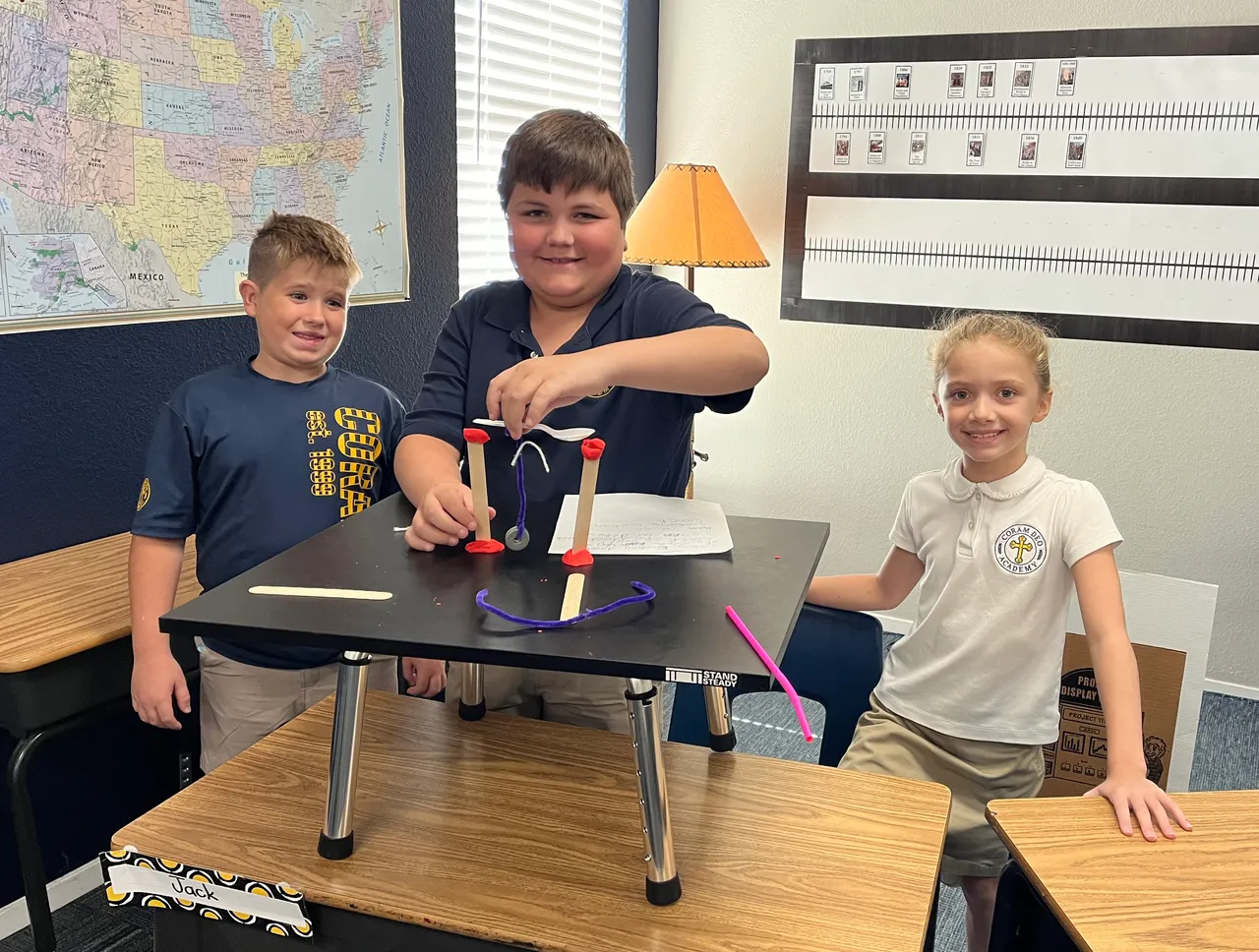
Many are familiar with the acronym STEM, which stands for science, technology, engineering, and math. STEM studies denote an umbrella of disciplines related to specific occupations. STEM courses have a utilitarian end goal for a particular use. The modern goal of education is to teach students narrow skills to fulfill predicted jobs needed in the modern economy. “However, what is needed are those individuals who know how to think and how to communicate.”1 In contrast, STEAM is not just an acronym, but rather a philosophy of learning in which the students are presented with open-ended challenges engaging the imagination and stirring inquiry.
The “A” in STEAM represents Arts. By engaging the arts along with the other subjects, the trivium, which is the art of language, is developed. The arts are displayed in a two-fold manner. Firstly, each team has a presenter, who must speak to the other teams describing the team’s procedures and strategies of construction. They articulate their team’s thoughts or reasoning in terms of explaining logic, successful or flawed efforts, or new areas of discovery. This provides the opportunity for inquiry by posing questions to the presenter or engaging other teams to question or comment. All three stages of the trivium are engaged in STEAM along with the quadrivium, which is the art of mathematics. Students are willing to speak freely since the focus isn’t solely on the product, but rather a discussion addressing the journey. Secondly, some targeted challenges focus specifically on the arts. For example, teams may create a bat that flies, along with composing and reciting a haiku poem that utilizes bat vocabulary. Teams may be challenged to create a brand-new, non-verbal language to convey a message, or a new instrument that produces sound.
The teacher serves as a guide but does not provide detailed blueprints or expect a specific solution. Students work in multi-grade teams and are confronted with many constraints such as time and materials. A growth mindset is built upon the ability to make a second iteration whereby good ideas are made even better. Students see challenges as opportunities to grow and push beyond obstacles. This creates a love of learning and a resilient attitude.
Teams pass through the engineering process of recognizing the challenge, imagining ideas, collaborating, assessing, and evaluating. STEAM develops self-confidence, creative and critical thinking, team building, problem solving, risk taking, project management, perseverance, and communication skills.
In a liberal arts education, students are free to pursue knowledge for the enjoyment of the journey. They are learning how to inquire and reflect. In the words of Dorothy Sayers, “The sole purpose of education is this ... to teach men how to learn for themselves and whatever instruction fails to do this is effort spent in vain.”2 So why does STEAM matter? According to the U.S. Department of Labor, 65% of today’s students will be employed in jobs that have yet to be invented. “The skills required for success in the modern world are general and diverse, and the ability to think in complex ways, to imagine, to communicate—these are the skills the economy needs, and they are in short supply.”3 Author Eva Brann says, “The liberal arts scheme, has a time-tried integrity—it is at least arguable that language and mathematics are in fact the two root activities of the human understanding … just because they are root skills, they are always applicable to new matter. A faculty forgoing fields and departments in favor of the arts will not be doing what is sufficient but, perhaps, what is necessary.”4 STEAM is a wonderful course allowing students the freedom to develop global skills by becoming confident creators and practice the essential skills needed to thrive in an ever-changing world.
Our Campuses
Administrative Office